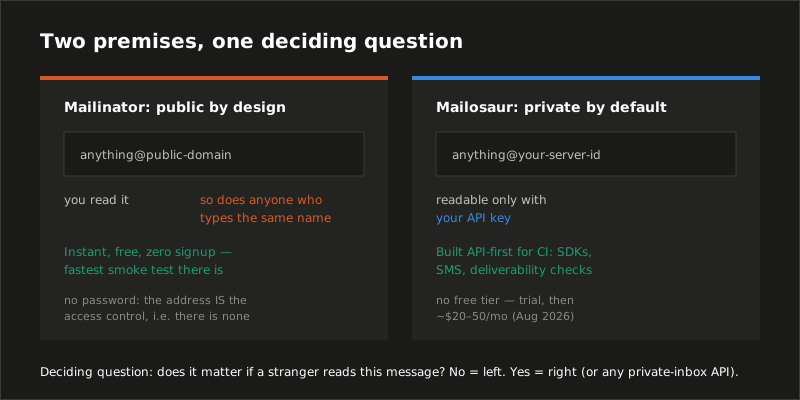
Mailosaur and Mailinator get compared constantly because both put a receivable inbox behind an API — but they were designed from opposite premises. Mailinator's founding idea is the public inbox: type a name, it exists, anyone can read it, $0. Mailosaur's is the private inbox: paid, scoped to your account, built API-first for CI. Which one fits depends on a single question most feature lists skip: does it matter if a stranger reads the message? Below: what each does well, current verified pricing, and the honest cases where neither is the right tool.
Disclosure up front: we run TempMaily, a disposable-inbox service with its own testing API, so we compete with both at the edges. All pricing below comes from the vendors' own pages as of August 2026, and we've dated everything so you can tell when this post ages.
Quick answer
Mailinator wins for manual smoke tests and quick "did the email send at all" checks: no signup, instant public inboxes, free. Mailosaur wins for serious automated testing: private inboxes by default, an API and SDKs designed for the CI polling loop, SMS testing, deliverability checks — from about $20/month (Personal) or $50/month (Core, billed annually). Mailinator's private tiers changed in 2026: a verified $0 tier now covers one private domain capped at 2,000 emails/month, then Business jumps to $79/month billed yearly. The rule of thumb: real tokens should never sit in a public inbox, so the moment your tests carry real verification codes, you're choosing between paid-private options — and at that point compare on API ergonomics and caps, not on Mailinator's famous free tier, which is no longer the tier you'd be using.
Two products from two premises
It helps to know what each tool was built to be, because both are excellent at their original job and awkward at the other's.
Mailinator popularized the public inbox. Any name at the public domain is a working address the moment someone sends mail to it — no signup, no creation step. That design makes it the fastest smoke-test tool in existence and a terrible place for secrets, simultaneously and for the same reason. The company knows this; the paid product is essentially "Mailinator's engine, but private": private domains, permanent storage, team seats, higher throughput.
Mailosaur started where Mailinator's free tier stops. Everything is private and account-scoped from the first request. The product's center of gravity is automated testing: official SDKs, an API shaped around create-poll-extract, SMS numbers alongside email, spam and deliverability analysis on higher tiers. There is no free public anything; there's a trial, then a subscription.
Neither premise is wrong. They're aimed at different moments in the same workflow — Mailinator at the manual check a human does in ten seconds, Mailosaur at the assertion a pipeline runs ten thousand times.
Pricing, precisely (August 2026)
Pricing comparisons in this category rot fast, so here are the current numbers with their source pages linked in Sources.
| Mailinator | Mailosaur | |
|---|---|---|
| Free | Unlimited public inboxes, temporary storage, API, webhooks, no signup | Trial only |
| $0 verified | "Verified Pro": private inboxes, 1 private domain, 10MB, 2,000 emails/mo (60/day), 1 seat | — |
| Entry paid | Business: $79/mo billed yearly — 50MB, 100K emails/mo, 5 seats | Personal: ~$20/mo |
| Next tier | Business Plus: $159/mo — 3 domains, 300K emails/mo, 10 seats | Core: ~$50/mo billed annually |
| Top end | Enterprise from $699 | Team/company plans |
Two things in that table surprise people. First, Mailinator's Verified Pro tier is new-ish and genuinely useful — a solo developer who needs a private inbox for light testing can now get one for $0 plus a verification step. Second, the crossover: once you exceed 60 emails a day, Mailinator's next stop is $79/month, which makes Mailosaur's $20–50 range the cheaper commercial option. The instinct that "Mailinator is the budget choice" is only true at volumes a real CI suite exceeds in its first hour.
The privacy question, since people search for it
"Mailinator public inbox privacy" is a query with a one-word answer: none, by design. A public inbox has no password and no owner; the address is the access control, and there isn't any. Academic work on disposable-email services has measured what that means in practice — a 2019 IEEE Security & Privacy study that monitored public temp-mail inboxes collected over 2.3 million emails and found tens of thousands of registration and password-reset messages sitting in publicly readable inboxes (Hu et al., IEEE S&P 2019). Mailinator is transparent about the model — public inboxes are the advertised feature, not a leak — but the operational rule follows directly: smoke-test with fabricated data in public inboxes, and put anything real behind a private one. We wrote more broadly about this in can temporary emails be traced?
The same design explains why signup forms often reject @mailinator.com addresses: the domain has been on public blocklists for years. If your test is "does our signup accept this email," a widely blocklisted domain skews the result — one more reason automated suites drift toward private-domain tools. More on that mechanic in why websites block temp mail.
Where each one actually wins
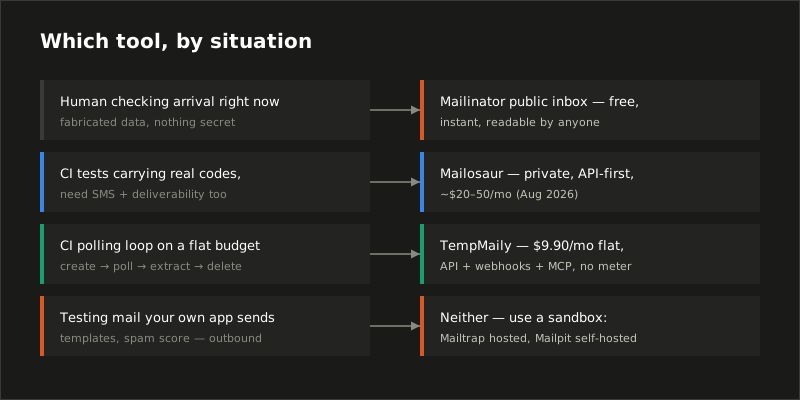
Choose Mailinator when:
- A human needs to check mail arrival right now with zero setup — the public inbox is still the fastest tool ever built for this.
- You're demoing or teaching and want an inbox the whole room can see. Public-by-design becomes a feature.
- Your volume fits under 60 emails/day and one private domain — the Verified Pro tier at $0 is hard to argue with.
Choose Mailosaur when:
- Tests run in CI and carry real codes. Private by default, API-first, SDK-supported — this is its home turf.
- You need SMS verification testing in the same tool as email.
- You want deliverability and spam analysis attached to the same inboxes your tests use.
Choose neither when:
- You're not testing software at all — you want a throwaway address for a signup. Both tools are aimed at developers; a consumer temp mail inbox does that job with less machinery, on a domain less blocklisted than Mailinator's public one.
- Your need is trapping outbound mail your own app sends. Both of these receive; a sandbox like Mailtrap or self-hosted Mailpit is the correct shape — the distinction we unpack in Mailtrap alternatives.
- The budget conversation stalls between Mailinator's caps and Mailosaur's subscription. This is the gap flat-priced inbound APIs occupy: TempMaily's API runs the same create-poll-extract loop at $9.90/month flat, no metering, which is our horse in this race — stated plainly so you can weigh it.
The migration-proof pattern
Whichever way you pick, wrap the provider behind your own helper. Every inbound testing service — Mailosaur, Mailinator, TempMaily, all of them — runs the same six-step loop: create an inbox, register with the address, poll with a timeout, extract the code or link, complete the flow, delete the inbox. Suites that hardcode one vendor's SDK across two hundred specs pay for that at every pricing change; suites that wrap it swap providers in one file. Our Cypress and Playwright guides show the wrapped version, and the QA test-address guide covers the address-hygiene half.
The short version to carry away: Mailinator for eyeballs, Mailosaur for pipelines, and check the current caps before assuming the free tier you remember still exists — that advice now applies to every vendor on this page, including the one writing it.
Sources
- Mailinator, pricing — free public tier, Verified Pro caps (2,000 emails/mo, 60/day, 10MB, 1 domain), Business $79/mo and Business Plus $159/mo billed yearly, as listed August 2026.
- Mailosaur, pricing — Personal ~$20/mo and Core ~$50/mo billed annually, as listed August 2026.
- Hu et al., Towards Understanding the Adoption and Security Risks of Disposable Email Services, IEEE Symposium on Security & Privacy 2019 — measurement of publicly readable disposable inboxes, including registration and reset emails found in them.
- Our adjacent comparisons: Mailinator alternatives, Mailosaur alternatives, and MailSlurp alternatives.