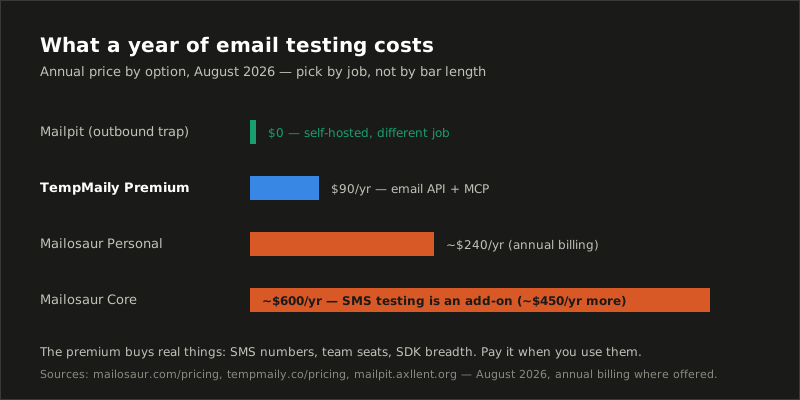
Mailosaur is a genuinely good product with a price built for QA organizations: plans start around $20/month billed annually — about $240/year — and the popular Core tier runs $50/month, with SMS testing as a paid add-on. If you are an org testing email and SMS across a five-person QA team, that math works. If you are a developer who needs to read signup codes in CI, you are being quoted enterprise tooling for a task that costs a tenth as much elsewhere. This comparison prices six alternatives by the job in front of you, not by feature-count tables.
Disclosure: we build TempMaily, one of the alternatives below — read that section as the operator talking. For the full email-testing landscape organized by job type, our best email testing tools guide is the wider map; the Mailtrap alternatives post covers the outbound-trapping direction in the same spirit as this one.
Quick answer
| If your job is… | Best-fit alternative | Cost as of Aug 2026 |
|---|---|---|
| Email-only verification tests, CI | TempMaily API | $9.90/mo flat |
| Email + SMS OTP flows | Mailosaur (stay) or MailSlurp | from ~$20/mo + SMS add-on |
| Maximum API flexibility | MailSlurp | free plan; paid scales |
| Tagged addresses, minimal setup | testmail.app | free tier; modest paid |
| Trapping your own app's outbound mail | Mailpit (different job!) | free, self-hosted |
| AI agents that need inboxes | TempMaily MCP server | included in Premium |
The rows are jobs, not rankings — a team with SMS flows should ignore the cheaper email-only rows entirely, and vice versa.
What you're actually paying Mailosaur for
Naming the value first keeps the comparison honest. Mailosaur's price buys four concrete things:
- SMS testing — real phone numbers your tests can receive OTPs on, alongside email. This is the rarest capability on this page.
- Mature SDKs in every mainstream language, with years of API stability behind them.
- Team structure — seats, servers-per-project organization, SSO and SLAs at enterprise tiers. Procurement-friendly.
- Unlimited addresses per inbox with high monthly message ceilings (Personal starts at 15,000 inbound emails/month).
If you just nodded at two or more of those, staying put is defensible and this post will not talk you out of it. The alternatives below exist for everyone who read that list thinking "I need maybe one of these."
The alternatives, by job
TempMaily (us — read accordingly): email-only tests at a flat $9.90
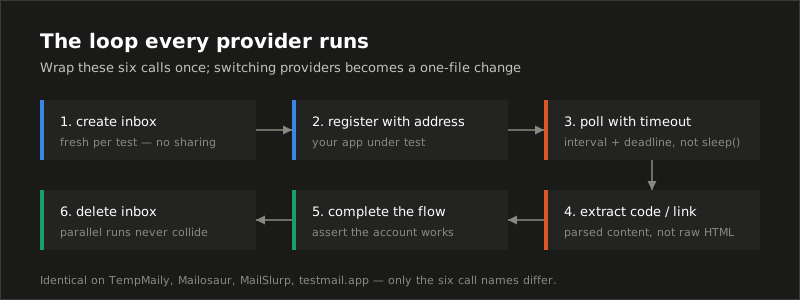
The core receiving loop — create a fresh inbox, register with it, poll for the message, extract the code, delete — is not a $600/year problem for an email-only team. TempMaily Premium is $9.90/month or $90/year flat, includes the REST API, and adds the one capability nobody else in this table has: an MCP server that lets AI agents (Claude, Cursor, custom MCP clients) create and read inboxes as native tools — relevant the day your test author or QA workflow is an agent.
What you give up against Mailosaur, stated plainly: no SMS numbers, no per-seat team administration, fewer official SDK wrappers (it is a straightforward REST API — the automation guide shows the whole loop in a few dozen lines). Framework recipes we maintain: Playwright, Cypress, Selenium, and CI patterns.
MailSlurp: the flexibility pick
The widest API surface in the category — inbox permutations, attachments, webhooks, aliases, and (unusually) both receiving and sending, plus phone-number support that makes it the most credible like-for-like Mailosaur rival when SMS matters. The honest trade: the API's breadth means more concepts between you and "read one OTP," and the pricing has moved upmarket — as of August 2026 the pricing page starts at $49.99/month with usage metering on top, and the free plan has retreated to the support docs. We broke down what that means (and the six ways out) in MailSlurp alternatives.
testmail.app: the minimalist
One namespace, unlimited tagged addresses (yourns.anything@inbox.testmail.app), a clean JSON API and GraphQL endpoint. No inbox lifecycle to manage at all — tags are free to invent per test. Free tier for small volumes. Best when your tests want addresses more than inboxes and you value setup time in minutes. No SMS, no MCP, minimal team features.
Mailpit: free — if you're actually testing the other direction
A surprising share of Mailosaur evaluations are for testing mail your own app sends — templates, staging safety, notification QA. That job needs no receiving service at all: Mailpit runs as a free container, catches everything your app sends, and exposes an assertion API. Before paying anyone for receiving, run the direction test: who sends the mail you need to see? If the answer is "we do," your alternative costs nothing.
Ethereal / GreenMail: the quick-experiment tier
Same outbound-direction caveat: Ethereal (Nodemailer's hosted fake SMTP) and GreenMail (embeddable JVM mail server) are free ways to see sent mail in dev and JVM test suites respectively. Not Mailosaur competitors — listed because evaluations keep comparing across the direction boundary without noticing.
Switching costs: what actually breaks
Moving between receiving APIs is cheaper than most tool migrations because the integration surface is small — but three things genuinely differ between providers and deserve a look before you commit:
- Inbox creation semantics. Mailosaur uses long-lived servers with unlimited addresses; TempMaily and MailSlurp create/destroy inboxes; testmail.app uses tags. Your test helpers change shape accordingly — usually a one-file change if you wrapped the provider (which you should).
- Polling vs webhooks. All support polling; webhook support varies. CI tests nearly always poll (simpler, no public endpoint needed), so this matters mainly for staging monitors.
- Message parsing. Check that the API returns extracted links/codes or clean text, not just raw MIME — re-implementing extraction is where migration time actually goes.
Common mistakes
- Paying for SMS capability in an email-only stack. The single most common overbuy. Audit which flows actually send SMS before renewing.
- Evaluating on the free trial's ergonomics only. Trials hide the constraint that bites later: message ceilings at full CI parallelism. Estimate emails-per-month as
tests × runs-per-day × 30before choosing a tier. - Sharing one inbox across parallel tests. The #1 flakiness source on every provider. One fresh inbox (or tag) per test, deleted afterward.
- Not wrapping the provider. A 30-line
createInbox / waitForMessage / extractCodewrapper makes every future migration a one-file change — and makes this comparison revisitable in an afternoon.
Try the $90/year version of the loop
If your flows are email-only, prove the loop before paying QA-org prices: open TempMaily and hand-test a signup right now, free — then wire the identical flow through the API on Premium. If it turns out you need SMS numbers after all, you'll know within the first test file, and Mailosaur or MailSlurp will be waiting.
Sources
- Mailosaur pricing — Personal ~$20/mo and Core ~$50/mo billed annually, 15,000+ inbound emails/month, SMS add-on from ~$37.50/mo, 14-day trial; retrieved August 2026.
- MailSlurp — API surface, free plan, and phone-number support.
- testmail.app — namespace/tag model and API.
- Mailpit — the free self-hosted outbound trap referenced in the direction test.
- Our own temp mail API documentation — endpoints and rate limits for the TempMaily loop described above.