Most "Mailtrap alternatives" comparisons rank ten sandbox products against each other and miss the actual situation: a large share of people searching this phrase discovered Mailtrap cannot do what they need at all — because they need to receive email from external services, and Mailtrap only traps email their own app sends. Those are opposite directions of mail flow, and no sandbox pricing tier fixes a direction mismatch. So this comparison starts one step earlier than the others: which job are you hiring for? Then the real alternatives for each.
Disclosure: we run TempMaily, whose API is one of the receiving-side options below — read that section accordingly. For the whole tooling landscape mapped by job, see our best email testing tools guide; this post goes deep on the two jobs Mailtrap searches actually mix together.
Quick answer
If you need to trap your app's outbound mail (Mailtrap's real job): Mailpit self-hosted (free, the modern MailHog), or stay on Mailtrap for hosted team features.
If you need to receive mail from external services (the job Mailtrap doesn't do): a receiving API — TempMaily ($9.90/mo with API + MCP), Mailosaur (from $20/mo, QA-suite incumbent), MailSlurp (deep API surface), or testmail.app.
| Tool | Direction | Model | Free tier |
|---|---|---|---|
| Mailtrap Sandbox | Outbound (trap) | Hosted | Small (≈50 test emails) |
| Mailpit | Outbound (trap) | Self-hosted, open source | Fully free |
| GreenMail | Outbound (trap) | Self-hosted, JVM-native | Fully free |
| Ethereal | Outbound (trap) | Hosted, Nodemailer | Free |
| TempMaily | Inbound (receive) | Hosted, API + MCP | Free web inbox; API on Premium |
| Mailosaur | Inbound (receive) | Hosted | 14-day trial, then from ~$20/mo |
| MailSlurp | Inbound (receive) | Hosted | Limited free plan |
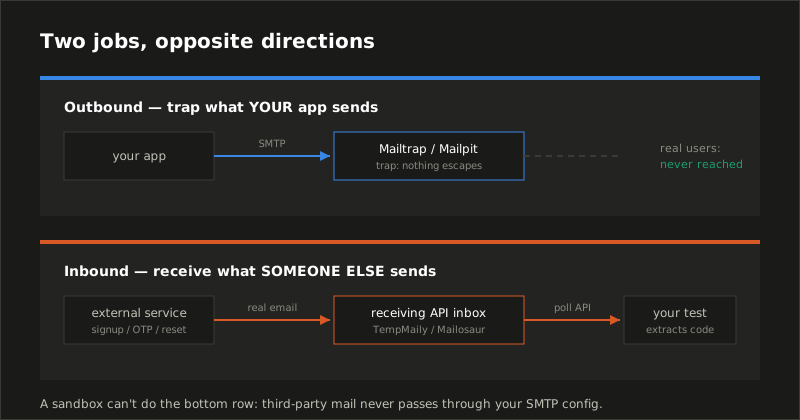
The direction test: 10 seconds to the right shortlist
Answer one question: who sends the email you need to see?
- Your own application sends it (welcome mail, invoice, notification templates) → you need a trap/sandbox. Your app points its SMTP at the tool; nothing escapes to real users. Mailtrap is in this category, and so are its true alternatives.
- Someone else's system sends it (the SaaS you're integration-testing, an OTP from a third party, mail from production infrastructure you don't control) → a sandbox is structurally useless, because that mail never goes through your SMTP config. You need a real receivable address with an API: a receiving service.
If you recognized yourself in the second bullet, skip the sandbox section entirely — no Mailtrap competitor priced at any tier solves your problem.
Job 1 — Trapping outbound mail: the real Mailtrap alternatives
Mailpit (our default recommendation)
Open source, a single Go binary or Docker container, real-time web UI, REST API for assertions, SMTP on one port and UI on another — up and catching mail in under a minute. It superseded MailHog (unmaintained since ~2020 but still everywhere in old docker-compose files; migrate when convenient, the API is close). For local dev and CI, Mailpit removes Mailtrap's two frictions at once: message caps and network dependency. There is no spam-score analysis and no hosted team inbox — that is the honest gap.
# docker-compose: the whole install
services:
  mailpit:
    image: axllent/mailpit
    ports: ["1025:1025", "8025:8025"]  # SMTP / web UI
Mailtrap itself (when staying is right)
Fairness requires the case for not switching: Mailtrap's hosted sandbox gives QA and marketing a shared web inbox with HTML/source/spam-signal views for every trapped message, with zero infrastructure. Free tier is small (on the order of 50 test emails); paid sandbox tiers run roughly $17–$123/month as of August 2026. If non-developers review templates in your workflow, that subscription is buying real convenience. If only CI reads the trap, Mailpit does it free.
GreenMail and Ethereal
GreenMail is the JVM-native pick — an embeddable fake SMTP/IMAP server that runs inside your Java/Kotlin test process, no container needed. Ethereal is Nodemailer's free hosted fake-SMTP: auto-generated credentials, messages viewable on the web, never delivered — fine for quick Node experiments, not for team workflows.
Job 2 — Receiving inbound mail: the alternatives Mailtrap can't be
This is the signup-verification, password-reset, OTP-extraction job: your test registers a fresh address somewhere, external infrastructure sends to it, your test reads the code via API. What matters here: inbox-per-test creation speed, polling/webhook ergonomics, SDKs, and price at your test volume.
TempMaily (us — read accordingly)
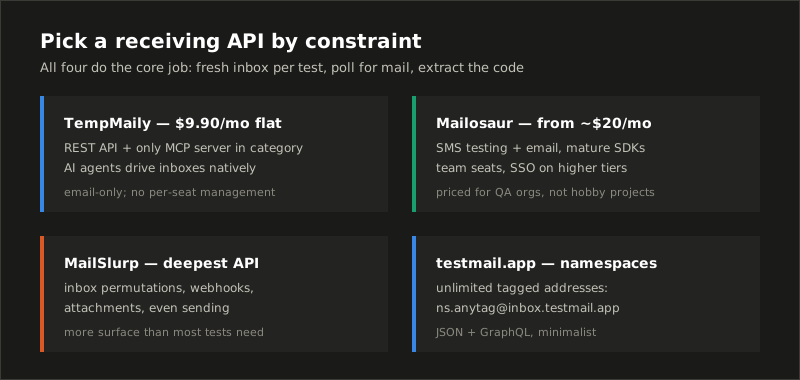
The budget-serious option: Premium at $9.90/month flat includes the REST API — create inboxes on demand, poll for mail, read parsed content, delete — plus an MCP server so AI agents (Claude, Cursor, custom) can drive inboxes natively, which none of the incumbents ship. The web inbox is free without signup, so you can prototype the flow by hand before automating it. Honest limits: email-focused (no SMS testing), and no per-seat team management — it is priced for developers and small teams, not procurement.
We maintain working end-to-end recipes for the big three frameworks: Playwright, Cypress, and Selenium, plus the general API automation guide.
Mailosaur
The QA-suite incumbent: mature SDKs across languages, SMS testing alongside email, team seats, SSO on enterprise tiers. Pricing starts around $20/month (billed annually) for the Personal plan and $50/month for Core as of August 2026. If your org tests SMS flows too or needs procurement-friendly structure, it earns the premium — our Mailosaur alternatives post is the deeper look at when it doesn't.
MailSlurp
The deepest raw API surface in the category: inbox permutations, attachments, webhooks, even sending. Generous entry pricing for individual developers; the free plan is enough to evaluate. The trade-off is that its breadth shows in the docs — expect more surface area than you need for "read one OTP."
testmail.app
Namespace-based receiving (unlimited addresses under your namespace) with a straightforward JSON API and GraphQL. A solid minimalist alternative when you want tagged addresses (ns.tag@inbox.testmail.app) rather than created-and-destroyed inboxes.
The two-tool stack most teams end up with
The categories compose rather than compete. The stack we see most, and run ourselves:
- Mailpit as a CI service container — every mail your app sends in tests is trapped, assertable, and free.
- A receiving API for end-to-end flows — one fresh inbox per signup/reset test, polled with a timeout, deleted after. No shared inboxes, no collisions between parallel runs.
Total cost: $0 for the trap, one small subscription for receiving. That combination covers both directions for less than most single mid-tier hosted plans.
Common mistakes
- Buying a bigger sandbox tier to fix a receiving problem. Direction mismatches don't scale away. If external mail needs to reach your test, no trap at any price is the tool.
- Testing with a shared static inbox. The #1 source of flaky email tests: parallel runs reading each other's messages. Fresh inbox per test, always — every receiving API above supports it.
- Leaving staging on real SMTP "temporarily." The classic incident is a re-run migration script emailing thousands of real customers from staging. Point staging at a trap the same day you create the environment.
- Keeping MailHog because it still works. It does — and it stopped receiving fixes years ago. Mailpit is the same workflow, maintained.
Start with the direction you're missing
If it's outbound: docker run axllent/mailpit and you're trapping mail in a minute. If it's inbound: open TempMaily for a free manual test of the flow, then wire the same thing through the API when it earns automation — or run both and cover the whole pipeline.
Sources
- Mailtrap — sandbox model, free-tier limits, and pricing referenced above, as of August 2026.
- Mailpit — features and API of the self-hosted trap; GreenMail for the JVM equivalent.
- Mailosaur pricing — Personal ~$20/mo and Core ~$50/mo (annual billing), August 2026.
- MailSlurp and testmail.app — receiving-API capabilities compared above.
- Ethereal — Nodemailer's fake SMTP service.