MailSlurp earned its user base with an API-first design and a free tier developers could actually build on. That second part has changed: as of August 2026 the pricing page starts at $49.99/month for Pro — capped at 100 email addresses — with usage metering on top ($3.00 per 1,000 inboxes created, $0.99 per 1,000 emails), and the free personal plan now lives in the support docs with real restrictions, not on the pricing page. If that pricing shape no longer fits how your test suite uses email, this post compares six alternatives by the job you actually hired MailSlurp for.
We run TempMaily, one of the six. Read our entry as an operator making its case; every competitor number here was checked against the vendor's own pricing page in August 2026 and is dated so you can tell when it goes stale.
Quick answer
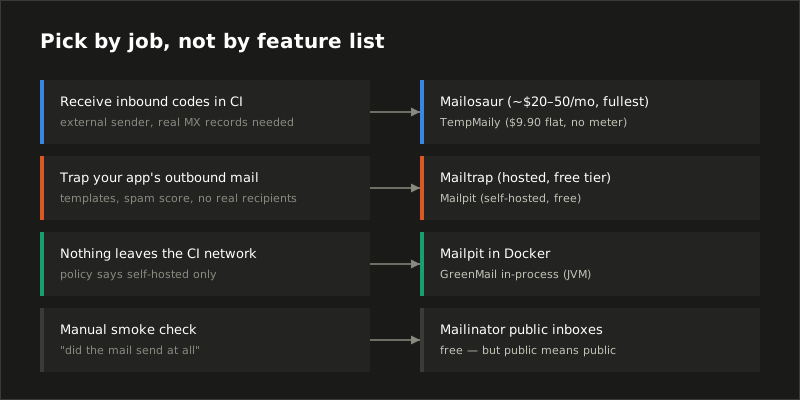
Pick your MailSlurp replacement by direction of mail flow. Receiving real inbound mail in automated tests (signup codes, password resets): Mailosaur if you want the fullest commercial feature set at ~$20–50/month, TempMaily if you want flat $9.90/month with REST polling, webhooks, and an MCP server. Catching outbound mail your own app sends: Mailpit free and self-hosted, Mailtrap hosted with a free sandbox tier. Fully inside CI with no external dependency: Mailpit in Docker or GreenMail in-process. Manual smoke tests: Mailinator's free public inboxes, with the caveat that public means public.
What changed, and why it sends people here
MailSlurp is not a worse product than it was. It receives real inbound mail at API-created addresses, ships SDKs for most languages, covers SMS and phone numbers, and does device rendering previews on the Growth tier. The reason "mailslurp alternatives" is a search worth writing for is the pricing shape, so let's state it precisely rather than grumble about it.
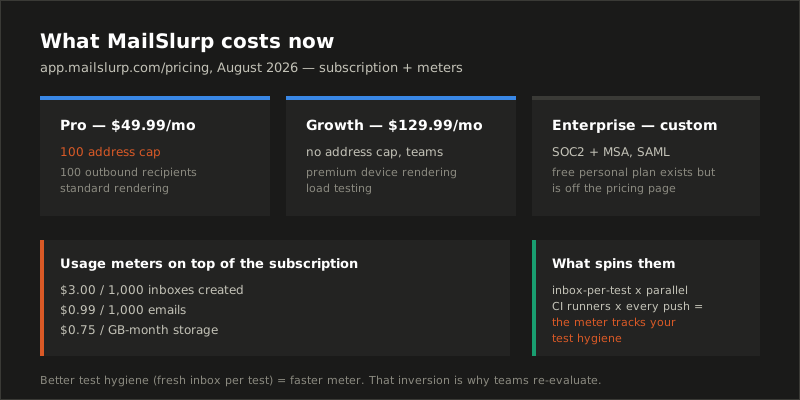
As of August 2026, MailSlurp's pricing page lists:
- Pro, $49.99/month — capped at 100 email addresses and 100 outbound recipients
- Growth, $129.99/month — no address cap, team access, premium device rendering, load testing
- Enterprise, custom — SOC2 paperwork, SAML/SCIM, audit logs
- Usage metering on all of it — $3.00 per 1,000 inboxes created, $0.99 per 1,000 emails, $0.75 per GB-month of storage
- A 7-day trial, and a free personal plan that no longer appears on the pricing page. The support docs note free accounts cannot send to addresses at major providers like gmail.com or yahoo.com, among other thresholds.
Two of those numbers matter more than the headline price. The 100-address cap on Pro collides directly with the inbox-per-test pattern — a healthy CI suite can mint a hundred addresses before lunch. And the per-1,000-inbox meter means the better your test hygiene (fresh inbox every test, parallel runners), the faster the meter spins. Teams that adopted MailSlurp because inbox-per-test was cheap are the ones re-evaluating now.
First, which MailSlurp were you using?
Every tool in this space does one of two jobs, and mixing them up is the most expensive mistake in the category:
- Inbound receiving — the service owns real MX records, so an external system (your production signup flow, a third-party SaaS) can send mail to an address and your test reads it. MailSlurp does this. So do Mailosaur, Mailinator, and TempMaily.
- Outbound trapping — the tool catches mail your own app sends over SMTP before it reaches anyone real, so you can inspect templates and assert delivery. Mailtrap, Mailpit, and GreenMail do this. They cannot receive mail from the outside world; nothing routes to them.
If your tests poll for a verification code sent by a system you don't control, only the first group replaces MailSlurp. If you pointed your staging SMTP config at MailSlurp to keep test mail off real users, the second group does the job cheaper — often free.
The six alternatives
Mailosaur — the fullest commercial replacement
The closest like-for-like swap for automated inbound testing. Private inboxes on your own server namespace, an API and SDKs designed for CI, SMS testing, spam and deliverability checks. As of August 2026 its pricing page lists Personal at about $20/month and Core at about $50/month billed annually — team seats and higher limits above that. We wrote up the full picture, including where it's overkill, in Mailosaur alternatives.
Skip it if you're a solo dev or small team and $50/month for email testing reads like a line item you'll have to defend. That's the gap flat-priced tools live in.
TempMaily — flat-price inbound API
Our product, so the pitch is short and checkable. POST /inboxes mints a private disposable address scoped to your Bearer key, GET /inboxes/{id}/messages returns what arrived with parsed bodyText to regex a code out of, expiry is a parameter (1d to never), webhooks are HMAC-signed, and an MCP server exposes the same operations to AI agents. One plan: $9.90/month flat, API included — no metering, no address cap, rate-limited at 300 requests per 60 seconds. Working Cypress and Playwright examples are in the docs.
Skip it if you need SMS testing, outbound trapping, or deliverability scoring — we don't do those, and the tools on this page that do them are better choices for those jobs.
Mailtrap — hosted outbound sandbox
The best-known sandbox. Point staging SMTP at it and every message your app sends is trapped for inspection: HTML preview, spam score, API assertions. Free sandbox tier (around 50 test emails), paid plans from roughly $17/month as of mid-2026. The catch that surprises people: it cannot receive external inbound mail, which we unpack in Mailtrap alternatives.
Skip it if your test needs to receive mail from a system you don't operate. Wrong direction.
Mailpit — free, self-hosted, outbound
A single Go binary or Docker container that catches SMTP traffic and exposes a REST API plus a clean web UI. In CI it's one service in your compose file; assertions hit localhost. It is the tool we recommend most often to teams who discover their "email testing" need was really "stop test mail reaching customers."
Skip it if you need inbound receiving or hosted anything. It sees only what you send it.
GreenMail — in-process, JVM-flavored
An open-source SMTP/IMAP server that starts inside your test process — famously as a JUnit rule — so the entire mail exchange happens in memory with no network egress. When security policy says test mail must not leave the machine, this is the answer.
Skip it if you're not on the JVM (possible elsewhere, less ergonomic) or you need external senders to reach the inbox.
Mailinator — free public inboxes, tiered private ones
Type any name at the shared domain and that public inbox exists — unbeatable for a manual "did the mail send at all" check. Since our earlier writeup, the pricing has shifted: as of August 2026 there's a verified $0 tier with one private domain capped at 2,000 emails/month (60/day), then Business at $79/month billed yearly. The structural caveat stands: free public inboxes are readable by anyone who types the address, so no real token should sit in one.
Skip it if your suite needs uncapped private inboxes on a small-team budget — the jump from the capped $0 tier to $79/month is the exact gap flat-priced inbound APIs occupy.
Decision table
| You used MailSlurp for | Replacement | Cost shape (Aug 2026) |
|---|---|---|
| Inbound codes in CI, full feature set | Mailosaur | ~$20–50/mo annual |
| Inbound codes in CI, flat budget | TempMaily | $9.90/mo flat |
| Trapping your app's outbound mail | Mailpit (self-host) or Mailtrap | Free / free tier + ~$17/mo |
| Everything inside CI, no external calls | Mailpit or GreenMail | Free |
| Manual smoke checks | Mailinator public inboxes | Free (public) |
| SMS + email together | Mailosaur | Paid tiers |
Migration notes from doing this a lot
The good news: every inbound service on this page runs the same six-step loop — create inbox, register with the address, poll with a timeout, extract the code, complete the flow, delete the inbox. If your MailSlurp usage is wrapped in a helper module, swapping providers is a one-file change. If it isn't, do the wrap first and thank yourself at the next pricing change — anyone's, including ours.
Three things to check before you commit anywhere:
- Run your actual suite against the trial, in parallel. Sequential eval traffic never trips rate limits; forty parallel CI workers do. This is where metered pricing and request caps show their real numbers.
- Confirm the direction twice. The single most common migration failure is replacing an inbound service with an outbound trap because the feature lists look similar. Send one real external email to a test inbox before writing any code.
- Price the inbox-per-test pattern specifically. Multiply tests × runs per day × 30. On a meter, that's your bill. On a cap, that's your ceiling. On flat pricing, it's neither — which is our argument, and now you have the numbers to check it.
If your flow is inbound polling with a fresh inbox per test, start with the API reference and the QA test-address guide — the trial takes less time than reading this post did.
Sources
- MailSlurp, pricing page — Pro/Growth/Enterprise tiers and per-unit usage fees, as listed August 2026.
- MailSlurp, free plan limitations — restrictions on free personal accounts, including blocked sending to major external providers.
- Mailosaur, pricing — Personal and Core plan pricing as listed August 2026; full analysis in our Mailosaur alternatives post.
- Mailinator, pricing — verified $0 tier caps and Business plan pricing as listed August 2026.