10 Minute Mail's timer is both the product and the problem. For a verification code that arrives while you watch, 10 minutes is plenty — and the enforced brevity is genuinely good privacy hygiene. But email is an asynchronous system: servers retry deliveries for hours, second codes arrive at first login, and the receipt you casually deleted a timer on turns out to matter tomorrow. This post ranks the alternatives by the one axis 10 Minute Mail users actually care about — how long the inbox lasts — and is honest about what each duration costs you.
Disclosure: we run TempMaily, one of the services below, so read that entry as the operator's pitch. If you want a broader comparison not organized around the timer, our best temp mail alternatives roundup covers the field, and how long does a temporary email last goes deeper on retention mechanics across the whole category.
Quick answer
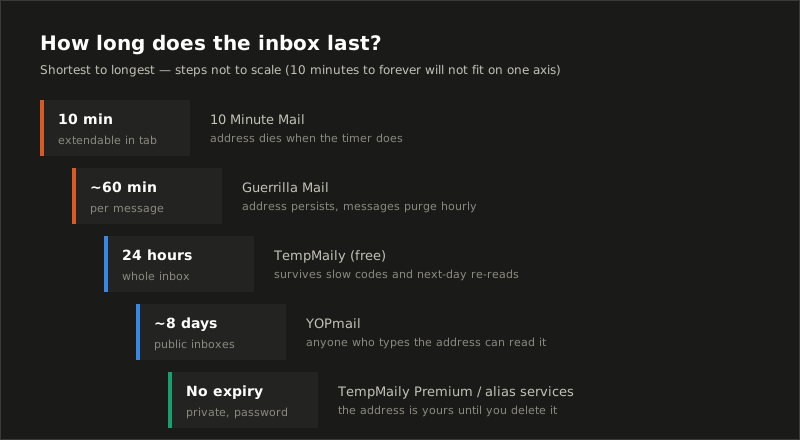
| Service | Inbox lifetime | The catch |
|---|---|---|
| 10 Minute Mail | 10 min, extendable while the tab is open | Nothing survives the tab |
| Guerrilla Mail | ~60 min per message; address persists | Messages purge hourly; public shared domains |
| TempMaily (us) | 24 h free; no expiry on Premium | Receive-only; Premium is paid ($9.90/mo) |
| YOPmail | ~8 days | Every inbox is publicly readable by design |
| mail.tm | Account-based, persists | Wants a signup — friction 10MM users left behind |
| SimpleLogin / Hide My Email | Permanent aliases | Forwards to your real inbox; different tool |
When 10 minutes is enough — and when it bites
Be fair to the timer first: most temp-mail jobs finish in under two minutes. Paste address, click verify, read code, done. If that is every use you have, 10 Minute Mail is not broken and you don't need an alternative.
The failures cluster at specific points on the timeline:
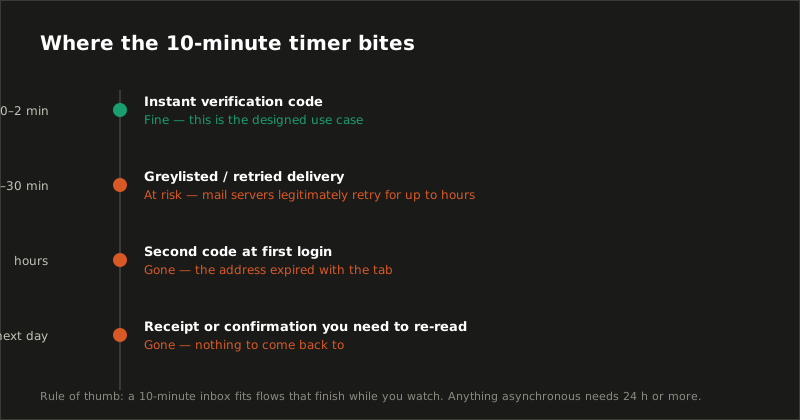
The middle row is the sneaky one. Greylisting — a standard anti-spam technique — makes receiving servers deliberately reject a first delivery attempt so the sender retries minutes later. A sender's queue under load can push that to an hour. Your code was "sent" inside the window and arrives at a dead address, and it looks like the site's fault when it is the timer's. We see the same failure pattern in verification emails that never arrive for other reasons — but with a 10-minute inbox you have added a race condition on top.
The last two rows are unfixable within the model: a second verification at first login (increasingly common), a receipt you need tomorrow, a slow waitlist confirmation. No amount of clicking "give me 10 more minutes" covers mail that arrives after you have moved on.
Inbox lifetime, compared
TempMaily (us — read accordingly)
The step we built for exactly this complaint: identical friction to 10 Minute Mail — open the page, address exists, no signup — but the inbox lasts 24 hours. That absorbs greylisting retries, second codes at first login, and the next-morning "wait, I need that receipt" moment, while still expiring fast enough that nothing accumulates. Messages render in a sandboxed frame that strips scripts and blocks tracking pixels. If you outgrow the free tier, Premium removes expiry entirely and adds password-protected inboxes, custom domains that signup forms don't reject, forwarding, and an API. What we deliberately don't do: outbound mail.
Guerrilla Mail
The middle rung. Each message lives about an hour, and the address itself is effectively permanent — you can come back to it, which 10 Minute Mail can't offer. You can even send mail, a near-unique feature. The costs: inboxes live on twenty-year-old shared domains that blocklists know by heart, and everything is public-model. Our full Guerrilla Mail alternatives comparison — including what a 2.3-million-email study found about services like it — is the deeper dive.
YOPmail
The retention champion of the free tier: about 8 days of message life, and any inbox name you invent is yours to revisit — because it is everyone's. YOPmail is public by design; no password protects any inbox, so anything@yopmail.com is readable by whoever types it. Great for watching a confirmation land across a week; wrong for anything attached to an account you value.
mail.tm
Worth one honest entry: mail.tm gives durable disposable inboxes behind an account and an API. The signup is exactly the friction most 10 Minute Mail users are trying to avoid, but if you want a persistent throwaway identity with programmatic access and don't mind registering, it is a legitimate option.
Alias services (SimpleLogin, addy.io, Apple Hide My Email)
If your real complaint with the timer is "I keep needing this address again," you have outgrown throwaways entirely. Aliases are permanent addresses that forward to your real inbox and can be revoked when they leak. Different privacy trade — the provider keeps a permanent alias-to-you mapping — and the right tool for accounts you keep. The email alias vs temp mail comparison draws the line properly.
What "deleted after the timer" really means
One more evidence-based caution before you pick a replacement on advertised retention numbers. In the largest measurement study of disposable email services (IEEE S&P 2019 — seven services, three months, 2.3 million emails), researchers checked whether services actually delete mail when they say they do:
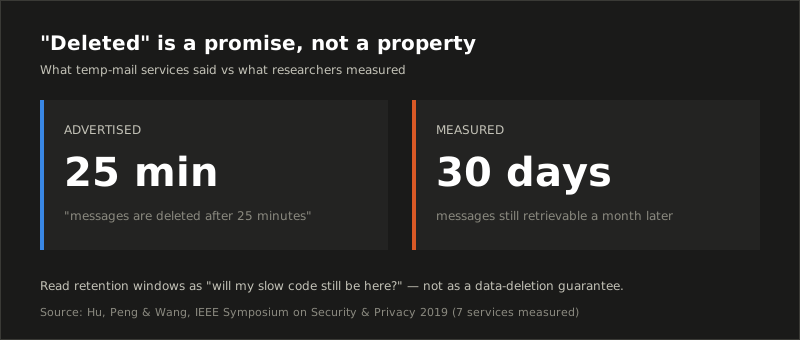
Some services advertising deletion "in 25 minutes" held messages retrievable for up to 30 days. The practical reading: treat a retention window as a minimum availability promise (my slow code will still be here) and never as a deletion guarantee (my data is provably gone). If genuine deletion matters to you, the fix is not a shorter timer — it is sending less sensitive material through any temp inbox in the first place. Our can temporary emails be traced post covers what actually persists and where.
Common mistakes when replacing 10 Minute Mail
- Racing the timer instead of replacing it. If you have ever sat clicking "10 more minutes" while waiting for a retry, the model is wrong for your flow — the fix costs nothing.
- Picking YOPmail-style public inboxes for account signups. The IEEE study found 89,329 registration emails sitting in publicly readable inboxes. Public retention is only a feature when the mail matters to nobody.
- Judging services by advertised deletion times. See above — measured behavior diverged from claims by three orders of magnitude.
- Using any of these for accounts you must recover. Every service in this post, ours included, is the wrong answer for banking, government, or anything with money attached. That is what your real inbox (plus aliases) is for.
The 30-second test
Open TempMaily in another tab — the inbox is already live, no signup. Use it for your next signup, then close the tab and come back tomorrow: the difference from a 10-minute timer is self-explanatory. If forms keep rejecting shared temp domains on you, that is the moment for a custom domain, not another shared-domain site.
Sources
- Hu, Peng & Wang, Towards Understanding the Adoption and Security Risks of Disposable Email Services, IEEE Symposium on Security & Privacy, 2019 — the claimed-vs-measured retention findings and the 89,329 public registration emails.
- 10 Minute Mail — timer and extension behavior described above.
- Greylisting (Wikipedia) — why legitimate mail is deliberately delayed on first delivery attempts.
- YOPmail FAQ — public-inbox model and ~8-day retention.