YOPmail's pitch is genuinely different from most disposable email: every inbox already exists, keeps messages for about 8 days, and requires nothing to open — no signup, no session, not even a click. The catch is the same fact read in reverse: every inbox already exists for everyone. Anyone who types your inbox name reads your mail, triggers your password resets, and sees every code you have ever received there. This post compares seven alternatives against that exact trade-off — grounded in the largest measurement study ever run on disposable email, so you are choosing on evidence rather than marketing copy.
One disclosure up front: we run TempMaily, one of the alternatives below. Read that section as an operator making its own case. If you arrived here from a different service, we keep dedicated comparisons for Guerrilla Mail, Mailinator, and 10 Minute Mail, plus a general temp mail roundup.
Quick answer
| Alternative | Best for | Retention | Can strangers read it? |
|---|---|---|---|
| TempMaily | Private inbox, codes now; API + custom domains on Premium | 24 h free, no expiry on Premium | No — random private address |
| temp-mail.org | Familiar big-name swap | ~1–2 h free | No, but shared domains |
| Guerrilla Mail | Replying from a throwaway | ~60 min | Partially — scrambled alias helps |
| Maildrop | Fastest one-off check | Short-lived | Yes — public like YOPmail |
| Mailinator | QA teams (paid private tiers) | Minutes–hours free | Yes on free tier |
| AdGuard Temp Mail | Known-vendor trust | Short-lived | No — shared domains |
| SimpleLogin / addy.io / Hide My Email | Accounts you keep long-term | Permanent | No — forwards to your inbox |
The dividing line in that table is not features — it is the inbox model. Here is why that matters more than anything else on a spec sheet.
The public-inbox problem, measured
In 2019, security researchers published the largest study of disposable email services to date at IEEE Symposium on Security & Privacy: three months monitoring seven popular services, 56,589 inboxes, 2,332,544 emails analyzed. Two findings apply directly to YOPmail's model:
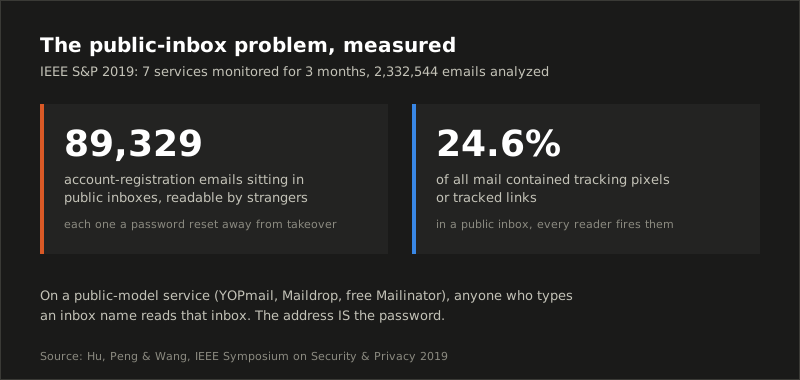
- Public inboxes accumulate real accounts. The researchers found 89,329 account-registration emails sitting in public disposable inboxes — each one an account a stranger could take over by typing the address and requesting a password reset. People treat "temporary" as "private," and on a public-model service those are opposites.
- A quarter of the mail tracks its reader. 24.6% of the 2.3 million emails carried tracking pixels or tracked links. In a public inbox, every stranger who opens your message also fires its trackers — and a Princeton study found roughly 30% of emails leak the recipient address to third parties on open.
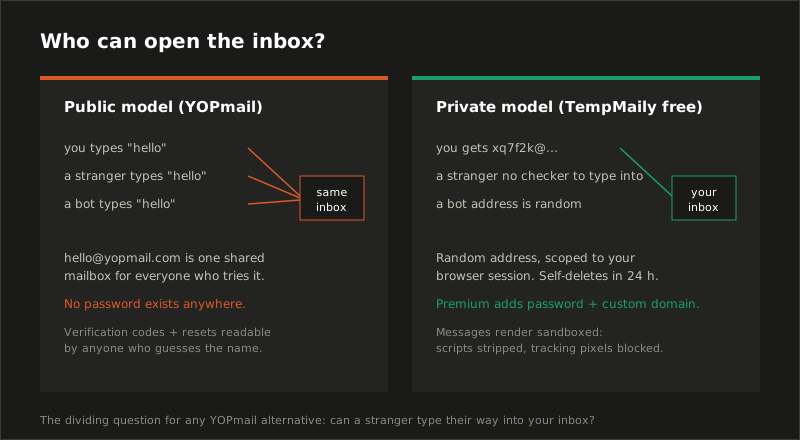
YOPmail is the purest example of the public model: inboxes are permanent, unauthenticated, and addressed by guessable names. That is not a criticism of the service — it is the design, and YOPmail is transparent about it. It just means the first question when choosing an alternative is who can read the inbox, and only then retention or UI.
What YOPmail gets right — and where it bites
Credit first, because YOPmail earns its popularity:
- 8-day retention is the longest free window in the category — most rivals measure retention in minutes or hours.
- Zero friction: any name you invent is already a working inbox, and alternate domains all feed the same inbox.
- Aliases and even YOPmail-to-YOPmail replies — small features most temp services skip.
- Two decades of continuous operation, which is more than most of this category can say.
The failure modes are just as specific:
- No privacy boundary at all. No password exists anywhere in the product. Anyone who guesses or reuses your inbox name is you.
- Guessable names are checked constantly.
test@,demo@, common first names — popular YOPmail inboxes are effectively shared property. Your verification code can be read, and your just-registered account hijacked, before you open the tab. - Blocklists know every domain. Twenty years of fame cuts both ways; signup forms reject YOPmail domains more each year. We wrote up why websites block temp mail — YOPmail is the canonical case.
- Receive-only for the outside world. Replies work only between YOPmail addresses, so any workflow needing outbound mail is out.
The alternatives, one by one
TempMaily (us — read accordingly)
The direct answer to the public-inbox problem. A free TempMaily inbox is a random address private to your browser session — there is no "inbox checker" where a stranger can type it, and messages render in a sandboxed frame that strips scripts and blocks the tracking pixels the study measured. The inbox lasts 24 hours: shorter than YOPmail's 8 days, deliberately — self-destruction is the product.
Where YOPmail has no upgrade path at all, TempMaily's Premium ($9.90/month or $90/year) adds what the public model can never offer: password-protected inboxes, addresses with no expiry, custom domains that pass blocklist checks because they are yours alone, forwarding, and a REST API + MCP server for test suites and AI agents. What we deliberately do not offer: sending, and public inboxes.
temp-mail.org
The biggest name in disposable email and the swap most people try first. Private-ish model (your address is generated, not typed-in-public), clean apps, and a premium tier with private domains. Free retention is short — on the order of one to two hours — and the shared free domains are as blocklisted as YOPmail's. If your complaint is only "sites reject yopmail.com," expect the same wall here; if your complaint is the public inbox, this fixes that much. Our temp-mail.org alternatives post covers its trade-offs in depth.
Guerrilla Mail
The veteran with the one feature almost nobody else has: sending mail out. Its scrambled-address mode also papers over part of the public-inbox problem by hiding the real inbox name behind an alias. Retention is the pain point — messages vanish after about an hour, against YOPmail's 8 days. Full comparison in our Guerrilla Mail alternatives guide.
Maildrop
YOPmail's model with a smaller footprint: public, guessable, type-any-address inboxes with aggressive spam filtering and short retention. It does not fix anything YOPmail users complain about — it is the same idea — but it is the simplest possible fallback when you need a second public inbox provider mid-task.
Mailinator
Worth naming because YOPmail's heaviest users are often testers, and Mailinator is the category's QA-team incumbent. The free tier is public exactly like YOPmail with far shorter retention; the real product is paid private domains and API access for teams. If that is your actual job, our Mailinator alternatives comparison and email testing tools guide go much deeper.
AdGuard Temp Mail
A minimal shared-domain temp inbox from the company behind the AdGuard ad blocker. Fewer features than YOPmail — no aliases, no multi-day retention — but a private-model inbox from an established privacy vendor with a reputation to protect. The pick when "who runs this service?" is your main criterion.
SimpleLogin, addy.io, Apple Hide My Email
The right tool for the job YOPmail users misuse it for: accounts you intend to keep. Alias services issue permanent addresses that forward to your real inbox and can be revoked when one starts leaking spam. If any YOPmail inbox of yours currently receives mail for a real account, moving that account to an alias (or at minimum a private inbox) is the single highest-value change on this page. The trade-offs between models are in our email alias vs temp mail breakdown.
How to choose
Match the inbox model to the job — not the service to a "best of" ranking:
- A verification code right now, nobody else reading it → a private-model instant inbox (TempMaily free, temp-mail.org, AdGuard).
- Re-checking the same inbox across several days, contents non-sensitive → this is YOPmail's actual sweet spot; staying put is legitimate, or Premium tiers add retention with privacy.
- A real account you will keep → alias service, or a private inbox with a password. Never a public inbox — that is the 89,329-emails finding.
- Automated tests or agents that need inboxes on demand → an API-first service; polling a public web inbox from CI is how flaky tests are born. Start with email verification testing via API.
- Sending from a throwaway → Guerrilla Mail, full stop.
Common mistakes when leaving YOPmail
- Recreating the public-inbox habit elsewhere. Switching to Maildrop or Mailinator's free tier changes the logo, not the exposure. If privacy sent you here, the fix is a private-model inbox.
- Assuming your new provider's domains are cleaner. Every popular shared domain converges on the same blocklists. When acceptance matters, the answer is a custom domain, not provider roulette.
- Judging services on advertised retention. The IEEE study caught services storing "25-minute" mail for 30 days. Read retention as minimum availability, not as a deletion guarantee.
- Using any temp inbox for recovery-critical accounts. Eight days feels long until the password reset you need arrives on day nine. Accounts you keep belong on aliases or permanent addresses — we say this as a temp-mail operator.
Try the private version of the same idea
If YOPmail's zero-friction inbox is what you like, TempMaily gives you the same no-signup instant address — except random, private to you, and sandboxed against trackers — live for the next 24 hours. If the 8-day retention is what you like, Premium keeps addresses indefinitely and puts a password on the door.
Sources
- Hu, Peng & Wang, Towards Understanding the Adoption and Security Risks of Disposable Email Services, IEEE Symposium on Security & Privacy, 2019 — the 2,332,544-email / 56,589-inbox study; source for the 89,329 leaked registration emails and 24.6% tracking figures.
- Englehardt, Han & Narayanan, I never signed up for this! Privacy implications of email tracking, PoPETs 2018 — ~30% of emails leak the recipient's address to third parties on open.
- YOPmail — public-inbox design, ~8-day retention, alternate domains, and alias features described above.
- Have I Been Pwned — 17.76 billion breached accounts as of July 2026, the background risk that makes disposable addresses worth using at all.