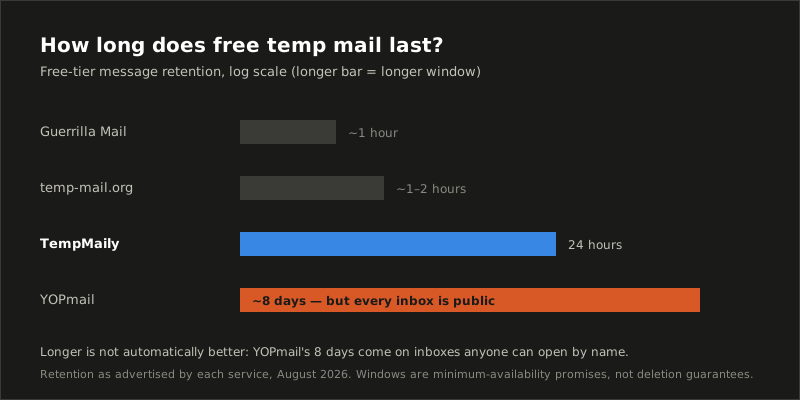
Temp-mail.org is the default name in disposable email — the site most people mean when they say "temp mail." It is also a service whose free tier keeps messages for only one to two hours, wraps the inbox in ads, and hands out addresses on the most blocklisted domains on the internet, precisely because it is the default name. If one of those three limits sent you searching, this comparison is organized around them: retention, experience, and acceptance — with the privacy evidence from the largest study of disposable email included, since switching services without switching models fixes nothing.
Disclosure up front: we operate TempMaily, one of the alternatives below — read that section as the operator's own pitch. We also keep brand-specific comparisons for YOPmail, Guerrilla Mail, Mailinator, and 10 Minute Mail, and a general roundup if you want the whole field at once.
Quick answer
| Alternative | Fixes which temp-mail.org limit | Retention | Model |
|---|---|---|---|
| TempMaily | Retention (24 h free), tracker-blocking, working API | 24 h free, no expiry on Premium | Private address |
| YOPmail | Retention (~8 days) — at the cost of privacy | ~8 days | Fully public inboxes |
| Guerrilla Mail | Adds outbound sending | ~60 min | Shared, scrambled alias |
| AdGuard Temp Mail | Cleaner, vendor-backed experience | Short-lived | Private address |
| Maildrop | Zero-friction one-off check | Short-lived | Public, guessable |
| Mailinator | Team QA with paid private domains | Minutes–hours free | Public free tier |
| SimpleLogin / addy.io / Hide My Email | Acceptance + permanence for real accounts | Permanent | Alias → your real inbox |
No alternative fixes all three limits for free. Each fixes one or two — pick by the limit that actually sent you here.
Before you switch: the model matters more than the brand
The largest measurement study of disposable email — 2,332,544 emails across seven services, published at IEEE S&P 2019 — found 89,329 account-registration emails sitting in public inboxes readable by strangers, and tracking in 24.6% of all mail. Temp-mail.org actually comes out of that comparison reasonably: its addresses are generated rather than typed into a public checker, so it is a private-model service like TempMaily or AdGuard, unlike YOPmail, Maildrop, and free Mailinator where the address is the only key.
The practical rule: if you are leaving temp-mail.org, do not accidentally downgrade to a public-model service for anything involving a real account. Retention and ads are annoyances; a stranger reading your password-reset mail is a takeover.
Why people actually leave temp-mail.org
- The retention window. One to two hours covers an instant code and nothing else. A confirmation that lands at hour three, a link you want tomorrow, a code re-requested from another device — gone.
- Rejected addresses. Fame is the enemy: the category leader's domains are the first entries on every blocklist. Rotating domains is a treadmill — we broke down the mechanics in why websites block temp mail.
- The ad experience. A free temp-mail page is ad-supported almost by definition (ours included on some pages), but density varies a lot between services, and this is the most-cited soft reason for switching.
- "Coming soon" developer features. Premium advertises sending, webhooks, and an API as upcoming. If your use case is automated — QA suites, agents, CI — you need a receiving API that exists today, which changes which services are even candidates.
The alternatives, one by one
TempMaily (us — read accordingly)
The same core flow — open the page, get a private address, watch mail arrive in real time, no signup — with the three limits addressed directly. Retention: the free inbox lasts 24 hours, twelve times temp-mail.org's window, long enough for slow confirmations and next-morning re-reads. Privacy: messages render in a sandboxed frame that strips scripts and blocks tracking pixels (the 24.6% problem measured above). Acceptance: free shared domains face the same blocklists as everyone's — we are honest about that — which is why Premium ($9.90/month, $90/year) offers dedicated premium domains with less blocklist exposure and custom domains you own with none.
The developer difference is not "coming soon": the REST API and MCP server for AI agents are live, documented, and included in Premium — create inboxes, poll for verification mail, extract codes from tests or agents today.
YOPmail
The retention champion: about 8 days of storage on inboxes that permanently exist. The structural trade is total: every YOPmail inbox is public, readable by anyone who types its name, with no password anywhere in the product. For monitoring a newsletter signup across a week, excellent; for anything resembling an account, it is the model the 89,329-emails finding warns about. Full breakdown in YOPmail alternatives.
Guerrilla Mail
Running since 2006 and still the only mainstream temp service with real outbound sending — reply to a message from your throwaway, a feature temp-mail.org lists as coming-soon and most services (ours included) deliberately never build. Retention is roughly an hour, and the interface shows its age. If sending is your missing feature, this is your answer; our full comparison covers the rest.
AdGuard Temp Mail
The polish pick: a clean, minimal, private-model temp inbox from the company behind the AdGuard ad blocker. Feature-light — short retention, receive-only, no premium path to custom domains — but if your complaint with temp-mail.org is the ad-heavy experience and you want a name-brand operator, this is the closest thing the category has.
Maildrop
Public and guessable like YOPmail, minimal like nothing else: type an address, open the site, read the mail. No retention promises, aggressive spam filtering. The right tool for exactly one job — "I need to see one email, once, with zero setup" — and the wrong tool for everything the model implies.
Mailinator
The QA-team option. Free tier is public with retention in minutes to hours; the actual product is paid private domains, message APIs, and team features. If you reached for temp-mail.org to test signup flows at work, Mailinator's paid tier or the alternatives in our Mailinator comparison are the serious versions of that — and our email testing tools guide maps the whole space by job.
SimpleLogin, addy.io, Apple Hide My Email
The permanent fix for the accounts you were wrongly using temp mail for. Alias services issue durable addresses that forward to your real inbox, survive indefinitely, pass most disposable-domain checks (their domains are not always on blocklists, though some lists do include them), and can be revoked individually when one leaks to spammers. The mirror-image trade-off: the provider holds a permanent map from aliases to your identity. When each model wins is the subject of email alias vs temp mail.
How to choose in 20 seconds
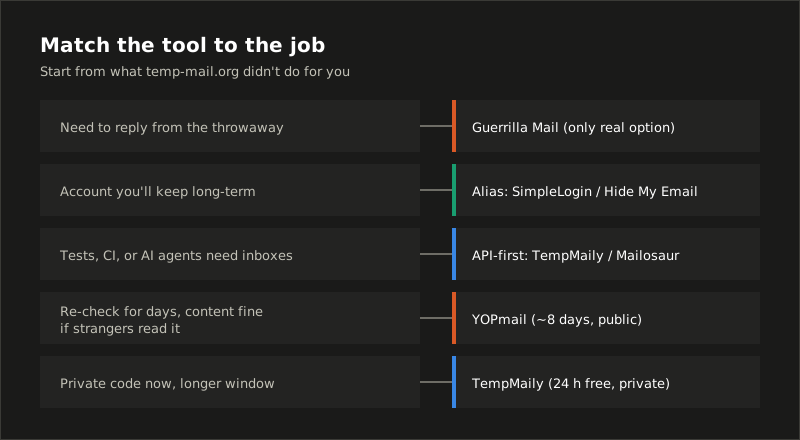
- Code right now, then forget it → any private-model instant inbox. TempMaily's lasts 24 h instead of 1–2.
- Need the mail still there in days → YOPmail if the content is harmless-if-public; a Premium/no-expiry inbox if not.
- Forms keep rejecting your address → stop rotating shared domains; use a custom domain or an alias service.
- Replying from the throwaway → Guerrilla Mail.
- Tests, CI, or AI agents → an API that ships today: TempMaily, Mailosaur, MailSlurp. Manual web inboxes do not automate.
- A real account you will keep → alias service, always. Temp mail — anyone's — is the wrong tool; we say so as a temp-mail operator.
Common mistakes when switching
- Confusing brand fatigue with model failure. If shared-domain rejection is your problem, every free shared-domain service will disappoint you on schedule. Only dedicated or owned domains exit the treadmill.
- Downgrading to public inboxes without noticing. YOPmail's and Maildrop's convenience is real; so is the fact that anyone can read your mail there. Match the model to the stakes.
- Betting workflows on "coming soon." Roadmap features are not features. If you need an API, sending, or webhooks, verify they exist and are documented before migrating anything.
- Treating retention windows as deletion guarantees. The IEEE study caught services storing "25-minute" mail for 30 days. Retention numbers tell you the minimum time your code will be available — treat deletion promises separately and skeptically.
The 24-hour version of the same idea
The fastest way to compare is to use one: TempMaily gives you a live private inbox for the next 24 hours, no signup, trackers blocked. If blocklisted domains are what sent you here, Premium's dedicated and custom domains are the exit — at $9.90/month, about the price temp-mail.org charges without the shipped API.
Sources
- Hu, Peng & Wang, Towards Understanding the Adoption and Security Risks of Disposable Email Services, IEEE Symposium on Security & Privacy, 2019 — the 2,332,544-email study behind the public-inbox and tracking figures.
- temp-mail.org and its Premium page — free-tier retention (~1–2 h), private-domain premium, and the coming-soon feature list described above, as of August 2026.
- Guerrilla Mail — outbound sending and ~60-minute retention.
- YOPmail — ~8-day retention on public inboxes.
- Have I Been Pwned — 17.76 billion breached accounts as of July 2026: why throwaway addresses exist at all.