Guerrilla Mail has processed north of eight billion emails since 2006, and for a free public throwaway inbox it still does the job. But the reasons people leave it are specific, not vague: messages vanish after roughly 60 minutes, every inbox lives on a shared public domain that signup forms increasingly reject, and there is no private inbox at any price. This post compares seven alternatives against those exact failure points — and grounds the privacy claims in the largest measurement study ever run on disposable email, so you are choosing on evidence rather than vibes.
One disclosure up front: we run TempMaily, one of the alternatives below. Read that section as an operator making its own case. For a general roundup that is not anchored to Guerrilla Mail, see our best temp mail alternatives list; if you are a developer choosing a testing inbox, the Mailinator alternatives comparison is the deeper page.
Quick answer
| Alternative | Best for | Retention | Inbox model |
|---|---|---|---|
| TempMaily | Codes now; private inboxes + API if you upgrade | 24 h free, no expiry on Premium | Private address; password + custom domain on Premium |
| temp-mail.org | Familiar like-for-like swap | Short-lived | Shared domains |
| YOPmail | Re-checking an inbox for days | ~8 days | Fully public by design |
| Maildrop | Zero-friction one-off checks | Short-lived | Public, guessable |
| AdGuard Temp Mail | Clean minimal UI from a known vendor | Short-lived | Shared domains |
| Mailinator | QA teams (paid tiers) | Minutes–hours free | Public free tier; private is paid |
| SimpleLogin / addy.io / Hide My Email | Long-term shield for real accounts | Permanent | Alias forwarding to your real inbox |
The rest of this post explains when each of those trade-offs bites, starting with the evidence.
What research actually found inside temp mail
Most "alternatives" posts recycle feature lists. There is better material available: in 2019, security researchers at Virginia Tech ran the largest measurement study of disposable email to date — three months monitoring seven popular services, including Guerrilla Mail — and published it at IEEE S&P, one of the top security venues.
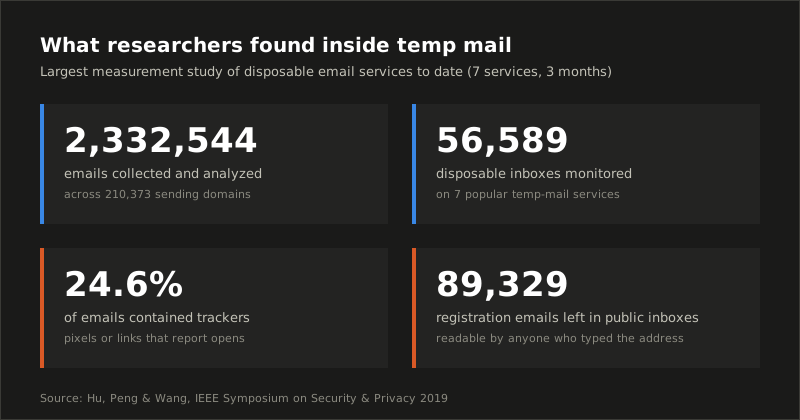
Three findings should drive your choice of alternative:
- Public inboxes leak real accounts. The study found 89,329 account-registration emails sitting in public disposable inboxes — readable by anyone who typed the same address. People sign up for real services with throwaway addresses, and on a public-model service, strangers can then trigger and read password resets.
- A quarter of the mail tracks you. 24.6% of the 2.3 million emails contained tracking pixels or tracked links that report when and where a message is opened. A separate Princeton study measured the adjacent problem in newsletters: about 30% of emails leaked the recipient's address to third parties when opened.
- Retention claims are unreliable. The researchers caught services holding mail for up to 30 days while advertising deletion in 25 minutes. "Deleted" is a promise, not a property — which is worth remembering when comparing retention windows below.
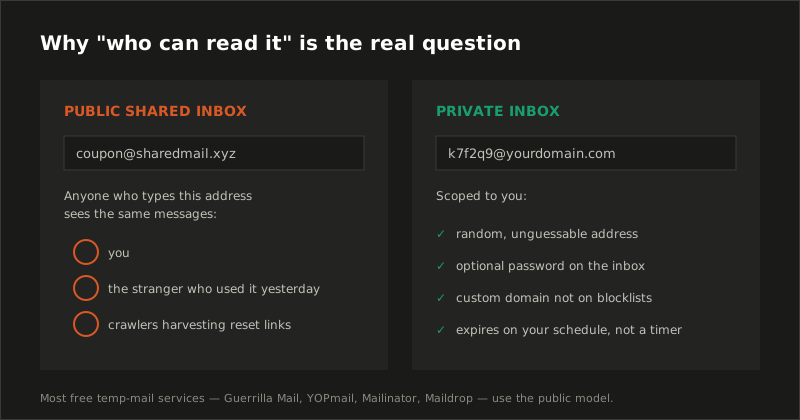
None of this says "never use temp mail." It says the public-inbox model — Guerrilla Mail's model — has a measurable failure mode, and that the useful dividing line between alternatives is who can read your inbox.
Why people actually leave Guerrilla Mail
To be fair to it first: Guerrilla Mail has run continuously since 2006, its address-scrambling hides your inbox name from shoulder-surfers, and it can send email — a genuinely rare feature that most alternatives, ours included, deliberately do not offer. If you need to reply from a throwaway address, stay put.
The friction is everything else:
- The 60-minute window. Messages are deleted after about an hour. Slow confirmation mails, second-device verifications, and anything you want to re-read tomorrow are gone.
- Blocklisted domains. Its shared domains have had twenty years to accumulate on every disposable-domain blocklist. More signup forms reject them each year — we wrote up why websites block temp mail and the mechanics apply squarely here.
- No private option. There is no paid tier that gives you a private inbox, a password, or your own domain. When you outgrow the public model, you must leave.
- The interface shows its age. Subjective, but it is the complaint that starts most searches for alternatives; ad layouts on the free temp-mail sites do not help.
The alternatives, one by one
TempMaily (us — read accordingly)
The like-for-like swap plus a growth path. The free tier does what Guerrilla Mail's public inbox does, with two differences that map to the study above: the free address is private to your browser session rather than a guessable public inbox, messages render inside a sandboxed frame that strips scripts and blocks tracking pixels, and the inbox lasts 24 hours instead of one — enough for slow codes and next-morning re-reads. No signup, no phone number.
The paid tier ($9.90/month or $90/year) exists for the moment the public model stops being enough: password-protected inboxes, custom domains that are not on any blocklist because they are yours, forwarding to your real inbox, no expiry, and a REST API plus MCP server if you want inboxes your tests or AI agents can drive. Guerrilla Mail has no equivalent at any price. What we do not offer: sending. TempMaily is receive-only by design.
temp-mail.org
The most popular name in the category and the swap most people make first. Instant address on a shared domain, clean enough UI, mobile apps, and a paid tier. The trade-offs are the category's usual ones: well-known domains that blocklists catch quickly and an ad-supported free experience. If you just want "Guerrilla Mail but fresher," this is that.
YOPmail
The retention outlier: messages persist about 8 days, and any inbox name you invent exists permanently. The catch is that YOPmail is public by design — no password anywhere, so anyone who types yourword@yopmail.com reads that inbox. That makes it great for re-checking a newsletter confirmation across a week and exactly wrong for anything resembling an account. The study's 89,329 leaked registration emails are the cautionary tale for using a service like this for signups.
Maildrop
Minimalist and genuinely frictionless: type any address, open the site, read the mail. Public and guessable like YOPmail, with aggressive spam filtering and short retention. Best as the "I need to see one email once" tool you can explain to anyone in a sentence.
AdGuard Temp Mail
The newest entrant on this list, from the company behind the AdGuard ad blocker. A clean, minimal temp inbox with the polish you would expect from an established privacy vendor. It is the alternative to pick if brand trust is your main criterion — a real company with a reputation to lose, in a category full of anonymous operators. Feature-wise it is a straightforward shared-domain receive-only inbox.
Mailinator
Worth naming because searches for Guerrilla Mail alternatives often really mean "testing inbox." Mailinator's free tier is fully public — inboxes readable by anyone, retention measured in minutes to hours — and its private inboxes and API live on team-priced paid plans. If that is your actual need, our Mailinator alternatives comparison covers the developer tools in depth.
SimpleLogin, addy.io, Apple Hide My Email
A different tool for a different job: aliases, not throwaways. These generate permanent addresses that forward to your real inbox, which is what you want for accounts you intend to keep — shopping, newsletters, anything with a login you will use again. You can revoke an alias that starts leaking spam. The privacy trade-off is the inverse of a burner's: the alias provider holds a permanent map from every alias to your real address. Our email alias vs temp mail breakdown covers when each model wins.
How to choose
The wrong way to choose is ranking services on a single "best" axis. The right way is matching the inbox model to the job in front of you:
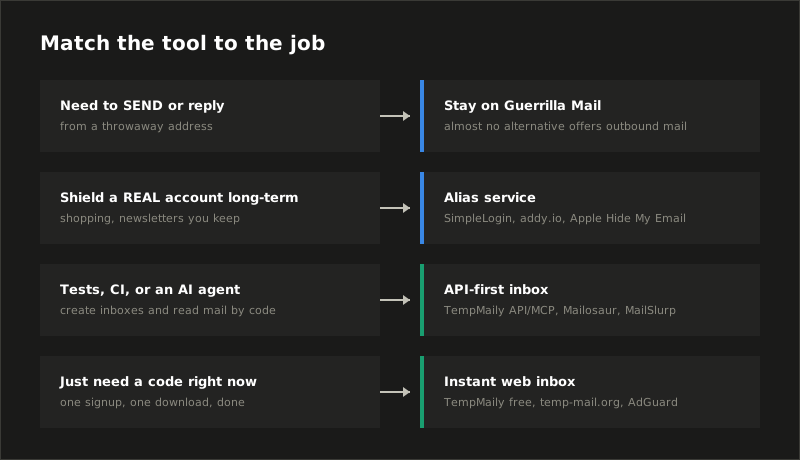
Two of those rows deserve a sentence each. If you need outbound mail from a throwaway, no swap will satisfy you — that is Guerrilla Mail's moat, keep using it. And if the job is a recurring one — QA flows, email verification in CI, agents that sign up for things — a web inbox you poll by hand is the wrong shape entirely; you want an API-first service regardless of which one.
Common mistakes when switching
- Using any public-model service for real accounts. The single clearest lesson from the research: 89,329 people registered accounts through inboxes strangers could read. If an account matters, use an alias service or a private inbox, never a guessable public one.
- Comparing on advertised retention. Services were caught keeping "25-minute" mail for 30 days. Treat retention windows as minimum availability promises (will my slow code still be here?) rather than deletion guarantees (is my data really gone?).
- Rotating shared domains to beat blocklists. Every shared domain ends up listed; you are on a treadmill. If forms keep rejecting your addresses, the exit is a custom domain, not a fourth temp-mail site.
- Expecting to send. Half the disappointment with Guerrilla Mail alternatives comes from assuming outbound mail is standard. It is not — verify sending exists before you migrate a workflow that needs it.
Try the 24-hour version of the same idea
If the one-hour window is what sent you here, the fastest test is direct: open TempMaily and you have a live private inbox for the next 24 hours, no signup. If what sent you here is blocklisted domains or the public-inbox problem, Premium's custom domains and password-protected inboxes remove both — for less than the cost of most alias services' paid tiers.
Sources
- Hu, Peng & Wang, Towards Understanding the Adoption and Security Risks of Disposable Email Services, IEEE Symposium on Security & Privacy, 2019 — the 2,332,544-email / 56,589-inbox study cited throughout.
- Englehardt, Han & Narayanan, I never signed up for this! Privacy implications of email tracking, PoPETs 2018 — ~30% of emails leak the recipient's address to third parties on open.
- Guerrilla Mail — retention window, scrambled addressing, and the outbound-sending feature described above.
- Have I Been Pwned — 17.76 billion breached accounts across 1,020 sites as of July 2026, the background rate that makes throwaway addresses worth using at all.